
Depression: What If We’ve Been Looking in the Wrong Place?


You can also experience this content in podcast format:

In this article you'll discover:
Why evidence doesn't support the simple “chemical imbalance” explanation of depression
Why genetics don't have to determine your destiny
How disconnection from Others, Nature and Self may contribute to depression
The role of subconscious beliefs, trauma and your inner environment
Why reconnection and subconscious work may be essential to lasting change
For decades, millions of people experiencing depression have been given a remarkably simple explanation for something profoundly complex:
"You have a chemical imbalance."
Usually, serotonin enters the conversation somewhere. The message was simple: Your brain isn't producing enough of the right chemicals. Something isn't functioning properly. Medication may correct the imbalance.
For someone suffering deeply, an explanation can initially be comforting. It gives the pain a name and, perhaps most importantly, tells them that what they are experiencing is real.
Depression is real. It can be devastating. It can affect sleep, appetite, energy, concentration, relationships, work, motivation, physical health, pleasure and a person's desire to participate in life at all.
But what if the explanation so many people were given for that suffering was never actually established by science? What if depression isn't simply something that has gone chemically wrong inside your brain? And what if accepting that explanation as the whole story has sometimes prevented us from asking much more useful questions?
Not simply "What is wrong with my brain?", but "What happened in my life, my relationships and my relationship with myself that brought me here?"
Depression: What If We’ve Been Looking in the Wrong Place?
Because when I work with depression, there is one place I continually want to investigate:
Where there is depression, look for the disconnection.
The Chemical Imbalance Story We Were Sold
Let's begin with something that may surprise you. The idea that depression is caused by a simple serotonin deficiency or chemical imbalance has not been established scientifically.
A major umbrella review published in Molecular Psychiatry examined the principal areas of research used to support the serotonin theory of depression. It brought together 17 systematic reviews, meta-analyses and large datasets and concluded that the major areas of serotonin research provided no consistent evidence that depression is caused by reduced serotonin activity or concentration.
So how did the chemical imbalance story become so widely accepted? That's a question worth asking. Research has previously documented a striking disconnect between the scientific literature on serotonin and the way the chemical imbalance explanation was presented to the public, including in antidepressant advertising.
However it became so widespread, a simple and compelling explanation became deeply embedded in public understanding—despite the science never establishing it as fact.
That doesn't mean serotonin has nothing whatsoever to do with mood, it doesn't mean the brain isn't involved in depression, and it doesn't mean antidepressants can never help.
It means something much more specific: The evidence does not support the simple story that depression is caused by a serotonin deficiency that antidepressants correct.
The World Health Organization describes depression as resulting from a complex interaction of social, psychological and biological factors—not simply a neurotransmitter shortage. This distinction matters because explanations become beliefs.
Imagine what happens when a person believes: "My brain is chemically defective. My body can't produce what I need to feel well. This is simply how my brain works. There is nothing I can do except manage it."
An explanation intended to remove blame can inadvertently remove agency too. I want to offer another possibility. Biology matters enormously. But “biology matters” is not the same thing as “your biology is defective.”
Your biology is not separate from your life. Your relationships are biological experiences, your thoughts are biological events, trauma leaves biological traces, safety has biological consequences, movement changes biology, sleep changes biology, nutrition changes biology, emotions change biology, connection changes biology, and psychological work can change biology too.
The alternative to a simplistic chemical explanation isn't a non-biological explanation.
It's a more complete one.
So Where Do Antidepressants Fit?
If depression hasn't been shown to result from a simple serotonin deficiency, an obvious question follows: What does that mean for antidepressants? It does not mean they can never help. And it certainly does not mean that someone currently taking them should suddenly stop. Doing so can be dangerous.
For someone in severe distress—particularly someone at acute risk—medication may sometimes provide an important bridge. In some circumstances, that bridge may be lifesaving.
But we need to distinguish between two questions: "Can something reduce the symptoms of depression?" and "Does it resolve what is driving that person's depression?" Those are not necessarily the same thing.
This is one of the most important distinctions I want to make in this article:
What if reducing the symptoms of depression and resolving what is driving a person's depression are two very different things? Sometimes we need help with the symptoms before we have enough strength to work on what lies beneath them.
But we shouldn't mistake the bridge for the destination. Or perhaps ask: What if the pill that helped you survive was never supposed to answer the question of why you were suffering?
Medication doesn't uncover why someone believes they are worthless. It doesn't restore a lost voice; it doesn't resolve childhood shame; it doesn't create meaningful relationships; it doesn't reconnect us with the natural world; it doesn't establish boundaries; and it doesn't teach someone that they are allowed to exist without continually earning their worth.
Those are questions of experience, connection and the beliefs we carry about ourselves — and they require us to look deeper.
Medication is also not the only evidence-based option for depression. Psychological therapies, exercise, and other interventions have substantial evidence behind them, and recommendations vary according to severity and individual circumstances.
So before asking only: “What can I take?”, I believe we should also be asking: “What am I disconnected from?”
If You Are Already Taking Antidepressants, Please Read This
This is extremely important. If you are currently taking antidepressants, do not stop taking them suddenly or change your dose based on anything in this article.
Questioning the chemical-imbalance explanation is not the same thing as saying that medication your body has adapted to can simply be removed. It would be dangerous to do so.
Antidepressant withdrawal is real and can be significant. If you want to explore reducing or eventually stopping medication, this should be planned with an appropriately qualified medical professional, using gradual tapering, monitoring and appropriate follow-up.
You do not need to wait until you are medication-free to begin doing the deeper work.
This isn't about suddenly taking something away.
It's about beginning to put back what may have been missing.
What About Genetics? Predisposition Is Not Predestination
Another belief I frequently encounter is: Depression runs in my family.
Sometimes that becomes: It's genetic. There's nothing I can do about it.
Genetics absolutely matter. Research has consistently demonstrated a heritable component to major depression. A major meta-analysis of family, adoption and twin studies estimated its heritability at around 37%. But that does not mean depression is genetically predetermined.
Predisposition is not predestination.
Your DNA is not a rigid instruction manual dictating every future outcome. Genes operate within extraordinarily complex biological systems and interact with development, behaviour, experience and environment.
This is where epigenetics becomes particularly interesting. Your DNA sequence and the activity of the genes contained within it are not the same thing.
Gene activity can be increased or decreased through regulatory processes, including epigenetic mechanisms. Stress, adversity, and other environmental experiences have been associated with epigenetic changes, and researchers continue to investigate their role in depression and many other conditions.
This does not mean that we can simply think a particular thought and consciously switch a “depression gene” off. Depression doesn't work like that. It means something more important: Our biology is dynamic and responsive.
Biological does not mean immutable.
Your genes may influence your vulnerability. They do not write your destiny. And when someone tells me depression “runs in the family,” I want to know what else ran in that family.
Because families don't transmit genes alone. They also pass on attachment patterns, ways of handling emotion, beliefs about love, beliefs about worth, responses to stress, relationship patterns, fear, silence, trauma, expectations, ways of communicating, ideas about what is safe, and ways of relating to ourselves.
What travels through generations isn't only genetic information. Families also transmit environments, behaviours, beliefs and ways of relating.
“This runs in my family” does not have to mean “This is my future.”
Your Outer Environment — and Your Inner Environment
When we talk about genes and environment, we usually imagine environment as everything outside us. And of course it is. Your outer environment includes your family, relationships, work, community, financial circumstances, home, food, sleep, movement, exposure to nature, stress, safety, trauma, and the experiences that have shaped your life.
But I believe we need to talk about another environment too. Your inner environment.
The beliefs you carry, the thoughts you repeatedly think, the expectations you have, the meanings you give events, the way you speak to yourself, whether you experience yourself as safe or unsafe, whether you believe you belong, whether you believe your needs matter, whether you believe you are worthy of love, and the relationship you have with yourself.
We don't only live in an outer environment, we live inside an interpretation of that environment.
Two people can experience similar events and give those events profoundly different meanings. And those meanings matter because the story you're living is influenced by the story you're telling yourself.
No one becomes depressed on purpose. No child deliberately decides "I'm going to believe I'm worthless."; "I'm going to believe nobody wants me. "I'm going to believe I have to be perfect to deserve love."
These beliefs can form as adaptations to experiences we did not choose. But once formed, they can influence how we think, what we notice, how we interpret what happens to us, how we feel, how we behave, and how we relate to other people and the world around us.
Those experiences and outcomes can then feed information back into what we already believe, creating a self-reinforcing loop.
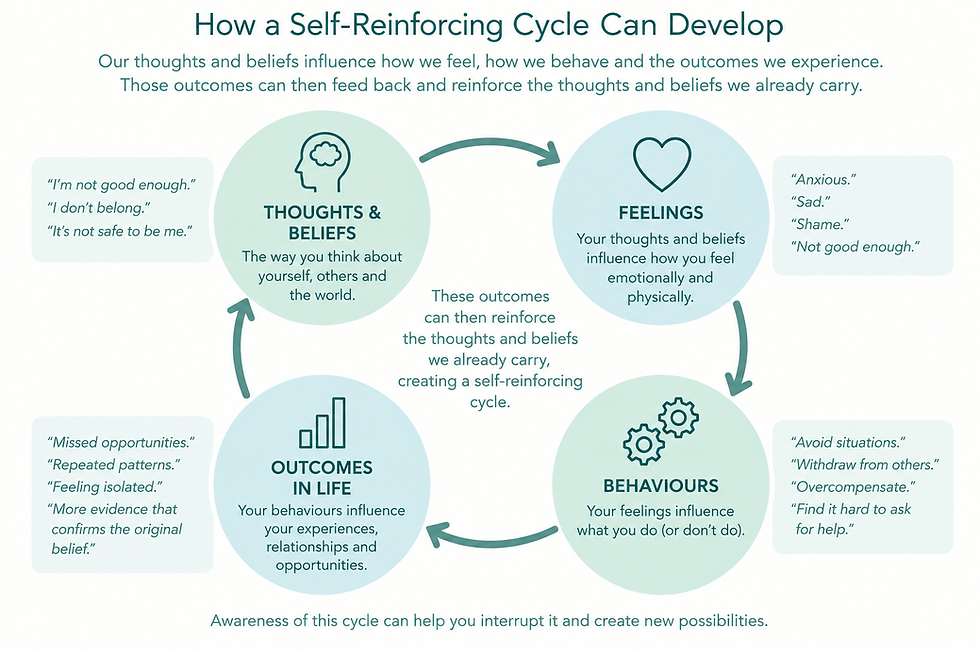
An emotional state repeated often enough can become an emotional habit. Familiar patterns of thought, feeling, and behaviour can become increasingly automatic—until what is familiar begins to feel almost inevitable.
What became familiar can feel inevitable, but familiar is not the same as permanent. This is where neuroplasticity—the brain's continuing ability to adapt through learning and experience—becomes so important.
If experience can participate in shaping biology, new experience can participate in reshaping it. New ways of thinking will bring new ways of experiencing life, others and ourselves.
Depression: What If We’ve Been Looking in the Wrong Place?
Depression is a recognised mental-health condition, and there are many pathways into it. I am not proposing that every person's depression has one identical cause; that wouldn't be true. I am proposing that we look somewhere we may not have been looking enough.
Where there is depression, look for the disconnection.
Depression is not the disconnection itself. Depression may be what emerges when essential connections have been lost. The idea of looking at depression through the lens of disconnection was profoundly influenced by Johann Hari's book Lost Connections. Hari travelled around the world interviewing researchers and exploring evidence that depression and anxiety may be connected not only to biology, but also to disconnection from other people, meaningful work and values, childhood trauma, status and respect, the natural world, and hope for the future. His work influenced my work with my clients and challenged me to think more deeply about what we may have lost—and what we may need to reconnect with.
In my work, I think about three in particular:
Connection to Others
Connection to Nature
Connection to Self
I call them the Three Connections.
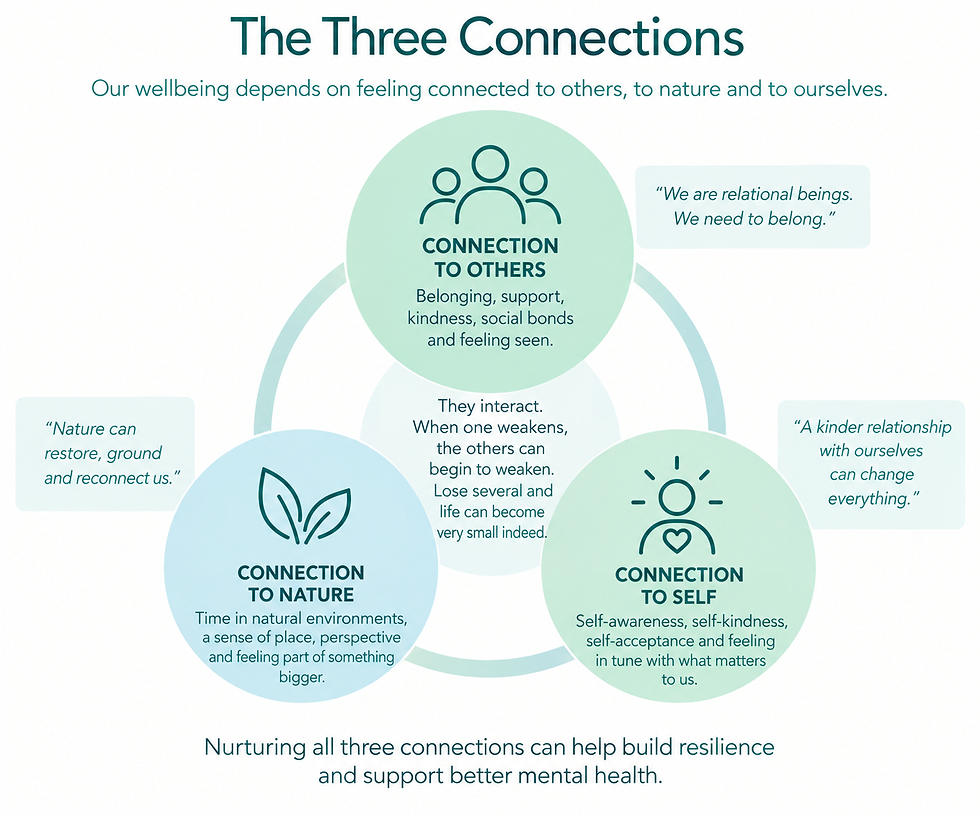
They interact. Lose one and the others can begin to weaken. Lose several and life can become very small indeed.
Connection One: Other People
Humans are relational beings. We need to belong. We need to be seen. We need affection, companionship, emotional safety, contribution, and the experience that somebody knows we exist and cares that we do.
The research linking social relationships and depression is substantial. Systematic reviews have found particularly consistent protective associations around emotional support, practical support and larger, more diverse social networks.
Large reviews of the wider evidence also identify social connection as an important determinant of depression.
Depression itself can make people withdraw, so the relationship can operate in both directions. But what I have observed is that disconnection often comes first. A relationship ended, someone died, we moved, we stopped seeing friends, we became a full-time carer, we began working remotely, we were bullied, we were rejected, we learned not to trust.
Or perhaps we have people around us but never feel truly known by them. You can be surrounded by people and profoundly lonely. Connection is not simply proximity. It is belonging.

Connection Two: Nature — Remembering That We Are Nature
Modern life has created another kind of disconnection. We spend extraordinary amounts of time indoors, under artificial light, looking at screens, sitting still, wearing shoes, living behind glass and concrete, separated from daylight, soil, water, trees, weather, seasons and the rhythms of the natural world.
We often talk about connecting with nature as though nature is somewhere we have to go.
And going there matters. Getting outside, seeing open sky, walking amongst trees, being near the ocean, feeling daylight on our skin, breathing outdoor air, moving our bodies. Experiencing the world through our senses rather than through another screen.
Research increasingly supports the mental-health value of nature exposure. Reviews of nature-based interventions have reported improvements in depressive mood, anxiety, and positive affect.
But there is another truth worth remembering:
We don't simply visit nature. We are nature.

The human body evolved in continuous relationship with the natural environment: Light, darkness, movement, temperature, air, water, earth, food, seasons—all of these provide information and inputs to our biology.
Sunlight and Daylight Matter
Getting outdoors reconnects us with something many modern lives lack: natural daylight and safe sun exposure. Human beings evolved in relationship with the sun.
Daylight helps regulate our circadian system—the biological rhythms involved in sleep, wakefulness, hormones, alertness and many other physiological processes.
Sun exposure also enables our skin to produce vitamin D. Vitamin D deficiency and insufficiency are common, and low vitamin D levels have repeatedly been associated with depression.
That doesn't mean vitamin D deficiency causes every depression, nor that taking a vitamin D supplement will resolve depression. But deficiencies matter. If the brain and body do not have what they need to function optimally, that deserves attention.
I encourage people to consider their vitamin D status and, where appropriate, discuss testing and supplementation with an appropriately qualified healthcare professional.
Put Your Feet on the Earth
There is also something extraordinarily simple that modern life has made increasingly uncommon: Direct physical contact with the Earth. Take your shoes off, walk on grass, stand on soil, walk along wet sand. This is often called grounding or earthing.
And yes, there may even be something to the instinct to touch a tree. Small experimental studies suggest that tactile contact with natural wood can produce measurable physiological relaxation responses. Perhaps the ‘tree huggers’ were onto something after all.
There is a measurable electrical component to grounding/earthing. The human body is electrically conductive. Connecting it directly to the Earth changes the body's electrical potential and allows charge exchange with the Earth's surface.
Research into the wider physiological effects of grounding is still relatively young, but the electrical connection itself can be measured.
The human body also generates measurable magnetic fields through electrical activity in organs including the heart and brain. I think of grounding as an energy reset—not because I am claiming that walking barefoot in itself treats depression. I'm not.
I think of it more simply as another small act of reconnection: taking off our shoes, stepping out of our insulated environments, and physically reconnecting with the Earth beneath us.
For most of human history, contact with the natural environment was not something we scheduled into our lives. It was simply part of being alive. Modern life has changed that dramatically. Perhaps reconnecting with nature doesn't require one dramatic intervention. Perhaps it begins with restoring some of the ordinary biological experiences modern life has quietly removed.
Sometimes reconnection can be wonderfully literal. Take off your shoes and touch the Earth.
What About Negative Ions?
There may also be aspects of our relationship with natural environments that science is still beginning to understand.
One example is atmospheric ions. Air contains electrically charged molecules and particles known as positive and negative air ions. Their concentrations vary according to environmental conditions. Natural processes—particularly moving water, waterfalls, forests, ocean surf and storms—can produce high concentrations of negative air ions.
Researchers have investigated whether negative air ions influence mood and mental health. Some research using high-density negative-ion exposure has reported reductions in depression ratings, although findings across the wider literature are mixed and the mechanisms remain uncertain.
Again, I don't think we need to turn this into: Negative ions cure depression. They don't. But it reminds us of something easily forgotten: Our environment is not biologically neutral. Light, air, water, movement, temperature, sound, landscape, and the physical characteristics of the atmosphere are all things our bodies encounter. Let's reconnect to it.
Move Your Body
Movement is another fundamental part of our relationship with nature because movement is part of being human.
A major 2024 network meta-analysis published in The BMJ, involving 218 studies and more than 14,000 participants with depression, found meaningful reductions in depressive symptoms with several forms of exercise, including walking or jogging, yoga and strength training.
This doesn't mean telling someone with severe depression: Go for a run. You'll feel better. When getting out of bed feels impossible, advice like that can feel insulting.
Start where you are. Walk for five minutes, stretch, swim, garden, move to music, feel your body again.
Movement isn't punishment for what you ate. It is one of the ways we experience being alive. It's a gift.
Nature Also Becomes Us Through What We Eat
Our connection with nature doesn't stop at our skin. Nature becomes part of us through what we consume. Food supplies the raw materials from which the body continually builds, repairs and regulates itself.
The brain is the fattiest organ in the human body. Once water is excluded, around 60% of its dry weight is fat. Those fats aren't incidental. Lipids are fundamental to the structure and functioning of the brain, which is one reason adequate nutrition—including essential fatty acids—matters.
Omega-3 fatty acids have important structural and functional roles in the brain and have been extensively investigated in relation to mental health and depression.
I am not a nutritionist, and nutrition isn't the primary focus of my work. But through my research, I encourage clients to think about whether they are giving their brain and body the nutritional building blocks they need—including essential fatty acids—and to seek appropriate nutritional or medical advice if they are concerned about deficiencies or considering supplementation.
Again, I am not replacing one simplistic deficiency theory with another. Depression isn't simply "not enough serotonin." And it isn't simply: "not enough omega-3."
The point is much bigger. The brain is an organ. It needs nourishment, it needs movement, it needs sleep, it needs light, it needs stimulation, it needs rest. And the human organism evolved within nature, not outside it. Nature is around us, but it also becomes us. These little things I am inviting you to look at all add up. Together, they support the body and brain, strengthen our connection with Nature, and can become an important part of recovering from depression.
Connection Three: Self
Of the Three Connections, this is the one I am most dedicated to because sometimes a person is disconnected from other people and from life partly because they have first become disconnected from themselves.
What does connection to Self actually mean? It means knowing what you feel, knowing what you need, knowing what you want, being able to say no, being able to say yes, having boundaries, having a voice.
Being able to receive love rather than continually chasing it. Allowing yourself pleasure, allowing yourself rest, allowing yourself to create, play, speak, disagree, grieve, become angry, take up space, be seen. It means knowing that your worth is not something you must continually earn. Connection to Self also means becoming aware of how you speak to yourself. Our self-talk can reveal the beliefs we hold about who we are, and when the same critical, fearful, or limiting messages are repeated often enough, they can begin to feel like truth.
Learning to notice those words and thoughts and deliberately replacing them with language that is kinder, more supportive, and more aligned with who we truly are and who we want to become, is an important part of changing our relationship with ourselves.
Connection to Self also means knowing what matters to you—what excites you, what you are drawn towards, what you are good at, and what gives your life meaning and purpose. I often describe this as knowing your heart's desire.
We can become disconnected from ourselves when we spend years living according to other people's expectations, suppressing our own interests and talents, or simply remaining on a path that no longer feels right for us.
I experienced the latter in my own life. During a vulnerable period, I chose to leave a career that was familiar and comfortable and step into something completely new. I had discovered work I felt deeply passionate about—helping people through RTT.
It wasn't about escaping something I disliked. It was about moving towards something that felt deeply meaningful to me.
Sometimes following our heart's desire requires us to leave what is comfortable, not because there is anything necessarily wrong with the life we have, but because something within us is asking to be expressed.
Of course, your heart's desire doesn't have to become your profession. It can be expressed through creativity, parenting, volunteering, caring, teaching, music, community, or countless other ways.
What matters is having somewhere in your life where who you really are gets to be expressed.
In my work, I have seen how significant this can be for people experiencing depression. Sometimes changing direction and beginning to build a life that feels meaningful to them becomes an important part of their recovery.
Reconnecting with Self can therefore mean asking some surprisingly difficult questions:
What do I actually want? What makes me feel alive? What would I choose if I weren't trying to please everybody else?
Connection to Self isn't only learning to love yourself. It is recovering permission to be yourself. Authentically. Unapologetically.
And the research around this connection is fascinating. A major meta-analysis of 77 longitudinal studies found that low self-esteem predicted later depression more strongly than depression predicted subsequent low self-esteem.
That matters. It suggests that low self-esteem isn't merely something that happens because someone becomes depressed. It can be a vulnerability that comes first.
Research into early maladaptive schemas is equally revealing. A systematic review and meta-analysis covering 51 studies and 17,830 people found all 18 schemas examined were associated with depression. Among the strongest associations were social isolation and defectiveness/shame.
Think about what those mean at the level of human experience:
I don't belong. There is something wrong with me. I am flawed. I am unlovable. I am not enough.
These aren't serotonin levels. They are beliefs about Self.

What Did What Happened to You Teach You About Yourself?
Trauma-informed approaches have helped move the conversation from “What's wrong with you?” towards “What happened to you?"
I want to take the question one step further: What did what happened to you teach you about yourself?
Because an event happens and then the mind gives the event meaning.
A child is repeatedly criticised—the event is criticism. The conclusion may become: I'm not good enough.
A parent leaves—the event is abandonment. The conclusion may become: People I love leave me. Or: I'm not worth staying for.
A child experiences abuse—the conclusions may become: I'm powerless; I'm unsafe; I'm worthless; My needs don't matter.
None of those conclusions necessarily reflects reality, but to the child who formed them, they can feel completely logical. Research consistently links childhood maltreatment with later depression, including increased risk of developing depression, earlier onset, and more persistent or difficult-to-treat presentations.
And trauma does not only mean catastrophic events. Sometimes what shapes us is what repeatedly didn't happen. We weren't listened to, we weren't praised, we weren't protected, affection was conditional, achievement was how we earned attention, emotion was inconvenient, being ourselves caused conflict.
So we adapted. Don't speak, don't feel, don't need, don't upset anyone, don't take up space, be who they need you to be. Sadly, that eventually can become: Don't exist.
This is why I find Marisa Peer's therapeutic description of depression as the opposite of expression so thought-provoking. What happens when a person learns that it isn't safe to fully express who they are?
What happens when they suppress their needs, their voice, their anger, their grief, their sexuality, their creativity, their boundaries, their authentic Self?
Trauma may steal someone's voice. Reconnection to Self involves helping them discover that they are allowed to have one again.
When Knowing Better Isn't Enough
Here's where things become particularly interesting.
You may consciously know “I am worthy of love,” and yet live as though “I am unlovable.” You may consciously know “That abuse wasn't my fault,” yet still carry shame. You may consciously know “I don't need everybody's approval,” yet experience rejection as unbearable.
Why? Because knowing something intellectually and believing it at a deeper level are not necessarily the same thing.
Knowing something isn't true is not always the same as no longer believing it.
Sometimes this gap can show up in behaviours we describe as self-sabotage—not because we consciously want to undermine ourselves, but because old beliefs, fears, and protective patterns can continue to influence our choices and responses long after we consciously know better.
This is one of the reasons I consider subconscious work essential when working with depression. Telling someone "Think positively, love yourself, stop worrying what people think" may achieve very little if the deeper beliefs remain: I’m not enough. I’m unsafe. I’m unwanted. I don’t matter. I have to please people to be loved. If people see the real me, they’ll leave.
The conscious thought may be the leaf. I want to know what's happening at the root.
Why Hypnosis and Subconscious Work Matter
Hypnosis allows us to work differently. Rather than only discussing the problem through the conscious analytical mind, hypnosis can help us explore the experiences, meanings, associations, and deeply held beliefs connected with it.
What happened? When did this feeling become familiar? What did you make that experience mean? What conclusion did you form about yourself? Is that conclusion actually true? What does your subconscious still believe? And who might you be without that belief?
Sometimes there may be one pivotal belief maintaining a great deal of the depressive pattern. Change the belief, and something profound can shift.
Other times there are layers. We may work with: "I'm not enough", and discover underneath it "I'm only valuable when I achieve." Then "If I'm not useful, nobody will want me." Or "If I'm myself, I'll be rejected." This is what I sometimes call peeling the onion. One layer reveals another.
And there is scientific evidence supporting hypnosis as a serious therapeutic modality. In a randomised controlled trial involving 152 people with mild-to-moderate major depression, hypnotherapy was found to be non-inferior to CBT, which is an established treatment for depression.
At 12-month follow-up, 44.6% of those receiving hypnotherapy met the threshold for treatment response compared with 38.5% of those receiving CBT. In other words, more than four in ten people receiving hypnotherapy experienced at least a 50% reduction in their depressive symptoms.
The evidence is promising, clinically meaningful, and deserving of considerably more research. The research into many of the psychological mechanisms subconscious work targets—self-esteem, shame, schemas, core beliefs, trauma, self-criticism and habitual cognition—is considerably larger.
Where RTT Fits
The method I use in my own practice is Rapid Transformational Therapy, or RTT. RTT is a relatively new integrative method, which means research specifically evaluating the complete RTT method is still emerging.
But hypnosis is not an optional addition to RTT. Hypnosis is its foundation. RTT combines hypnosis with techniques and principles drawn from several therapeutic approaches, including cognitive and behavioural methods, mindfulness, and other psychotherapeutic techniques.
For me, one of its greatest strengths is the ability to investigate the belief beneath the presenting problem.
I'm not simply asking What are you thinking today? I want to know: Why does that thought feel true? Where did you learn it? What happened? What did you decide that experience meant about you? And then we work to change the meaning and the belief.
In my experience, even one RTT session can bring remarkable relief and understanding. For someone who has spent months or years asking Why am I like this?, discovering experiences, meanings, and beliefs that may be contributing to or maintaining their depression can be extraordinarily powerful.
But that first session isn't necessarily the entire process. Complex issues can have layers. Depression and trauma may require several sessions. Something discovered during one session may reveal the focus needed for the next.
The goal is not simply symptom management. We are also looking for what may be contributing to or maintaining the pattern—and then working to change what can be changed.
And change doesn't end with insight. New beliefs, responses, and ways of relating to ourselves need opportunities to be reinforced through repetition and lived experience. The aim isn't simply to understand why a pattern developed, but to begin living differently without it.
The Three Connections Are Also a Way Back
This is why I don't see the Three Connections merely as an explanation for depression. They can also become a framework for recovery.
Reconnect with Others.
Reconnect with Nature.
Reconnect with Self.
Not all at once, not perfectly, and certainly not by blaming yourself for having become disconnected.
No one gets depressed on purpose. You did not deliberately choose the experiences that shaped you. You did not consciously choose the conclusions you formed as a child. You did not wake up one morning and decide that you wanted your world to become smaller.
But lack of blame does not have to mean lack of agency. What was learned can be challenged and changed. What became automatic can become conscious. What became familiar does not have to remain permanent.
Connection isn't one intervention. It's a way of returning to life. And subconscious work can support all Three Connections by helping us identify and change beliefs and patterns that may be standing in the way.
When Depression Includes Suicidal Thoughts
Sometimes depression becomes so painful that thoughts of suicide can enter the picture. If that is happening to you, please don't keep it to yourself.
You may be frightened to tell someone what you are thinking. You may worry about how they will react, what will happen next, or whether saying the words out loud will somehow make everything more serious. But suicidal thoughts are a sign that you are in enormous pain—and pain deserves support, not silence.
Tell someone you trust. Reach out to a qualified professional. Contact a suicide or crisis service. If you feel you may act on these thoughts or cannot keep yourself safe, seek emergency help immediately.
And please don't wait until things become unbearable before asking for help. Reaching out does not mean giving up your ability to understand and work on what lies beneath your depression. Getting support to help you through this moment and doing the deeper work of understanding your suffering are not opposing paths. You deserve both.
Most importantly, don't let fear of what might happen if you tell someone prevent you from telling anyone at all.
You do not have to carry suicidal thoughts alone. Say something. Tell someone. Let another person into what you are experiencing.
Perhaps We've Been Asking the Wrong Question
For a very long time, depression has often been presented to people as something fundamentally wrong inside their brain. A chemical imbalance. A genetic destiny. A defective system requiring correction.
I see something considerably more complex—and considerably more hopeful.
Biology matters, genetics matter, trauma matters, relationships matter, nature matters, movement matters, sunlight matters, sleep matters, nutrition matters, life circumstances matter. And the beliefs through which you experience all of those things matter.
Your biology is part of the story. But your biology is living, responsive, and influenced by the story you're living, and the story you're living is influenced by the story you're telling yourself.
That doesn't mean you caused your depression. It means you may have more influence over what happens next than you were led to believe.
So perhaps the first question isn't: What's wrong with me? Perhaps we begin with: What happened to me? Then go deeper—what did what happened to me teach me about myself?
And finally: What am I disconnected from? Other people? Nature? My body? Joy? Meaning? My voice? My needs? My worth? My authentic Self?
Because perhaps depression isn't only something to suppress. Perhaps sometimes it can point us towards something essential that has been lost. And if we can find the disconnection, understand how it happened, change the beliefs that keep it in place, and deliberately rebuild those connections, something else becomes possible.
Not blame—Agency. Not pretending everything is fine—Understanding why it isn't. Not forcing yourself to “think positively”—Changing the beliefs from which those thoughts arise.
Not simply returning to who you were before depression. Perhaps reconnecting with who you were underneath everything you learned you had to become.
Predisposition is not predestination. Biological does not mean immutable.
What became familiar does not have to remain permanent.
And where there is depression, look for the disconnection. Then begin finding your way back.
If this article resonated with you, know that the patterns contributing to how you feel do not have to define your future.
If you're ready to explore what may be underneath your depression—the subconscious beliefs, past experiences, and patterns that may be keeping you disconnected from yourself, others, or life—I'd love to support you.
Through subconscious work and hypnosis, we can begin to uncover where those patterns came from, transform the beliefs that no longer serve you, and help you reconnect with yourself and with the life you want to be living.
You can book a complimentary consultation through the link below, where we'll talk about what you're experiencing, what you'd like to change, and whether my approach is the right fit for you.
This article is intended for educational purposes and should not be considered a substitute for personalised medical or mental health advice. If you're concerned about your mental health or believe you may be experiencing depression or another medical condition, please consult a qualified healthcare professional.
Further Reading & Resources
Shame, Guilt, and Depressive Symptoms: A Meta-Analytic Review — Psychological Bulletin
Implicit Cognition and Depression: A Meta-Analysis — Clinical Psychology Review
Effects of Self-Compassion Interventions on Reducing Depressive Symptoms, Anxiety, and Stress: A Meta-Analysis — Mindfulness
Individual Behavioral Activation in the Treatment of Depression: A Meta-Analysis — Psychotherapy and Psychosomatics
Looking Beyond Depression: A Meta-Analysis of the Effect of Behavioral Activation on Depression, Anxiety, and Activation — Psychological Medicine
Earthing the human organism influences bioelectrical processes — The Journal of Alternative and Complementary Medicine
Frequently Asked Questions (FAQ) About Depression
Is depression really caused by a chemical imbalance?
The idea that depression is simply caused by low serotonin or a “chemical imbalance” has never been supported by the available evidence. Depression is far more complex and involves an interaction of biological, psychological, social and environmental factors.
This does not mean biology is unimportant. It means that “biological” does not necessarily mean “chemically defective.” Our biology is continually interacting with our experiences, relationships, environment and behaviour.
If depression runs in my family, does that mean I will always have it?
No. Genetics can influence vulnerability to depression, but predisposition is not predestination. Families also pass down environments, beliefs, behaviours, relationship patterns, responses to stress and ways of relating to ourselves.
Research into neuroplasticity and epigenetics further demonstrates that our biology is dynamic and responsive rather than a fixed sentence written at birth.
Should I stop taking antidepressants if depression isn't caused by low serotonin?
No. Do not suddenly stop antidepressants or change your dose based on this article.
Antidepressant withdrawal can be significant, and any reduction or discontinuation should be discussed and planned with an appropriately qualified medical professional.
Questioning the chemical-imbalance explanation is not the same as saying antidepressants cannot help. For some people, they can provide valuable symptom relief or an important bridge during a difficult period.
The question explored in this article is whether reducing symptoms and resolving what is driving an individual's depression may be two different things.
What do you mean by the “Three Connections”?
I use the Three Connections — Others, Nature and Self — as a framework for understanding some of the disconnection I frequently see around depression.
Others means belonging, relationships, support and meaningful human connection.
Nature means reconnecting physically with the natural world and with our own biological nature through things such as outdoor time, natural daylight, safe sun exposure, movement and nourishment.
Self means reconnecting with your needs, emotions, boundaries, voice, worth and authentic identity.
These connections influence one another, which is why rebuilding connection can happen in many different ways.
How can subconscious beliefs contribute to depression?
Experiences, particularly those occurring early in life, can lead us to form deeply held conclusions about ourselves and the world. These might include beliefs such as “I'm not enough,” “I'm unlovable,” “I don't matter,” “I'm unsafe,” or “I have to please people to be loved.”
We may consciously know these beliefs aren't true while still behaving and emotionally responding as though they are. This is why knowing something isn't true is not always the same as no longer believing it.
Subconscious work aims to identify where these beliefs came from, challenge the meanings attached to earlier experiences and establish healthier beliefs and patterns.
Can hypnosis help with depression?
There is promising clinical research into hypnosis and hypnotherapy for depression, including a randomised controlled trial in which hypnotherapy was found to be non-inferior to CBT for mild-to-moderate major depression.
However, the research base is smaller than that for established treatments such as CBT, and more high-quality studies are needed.
In my work, hypnosis is valuable because it allows us to explore the experiences, associations, and deeper beliefs that may be difficult to change through conscious understanding alone.
What is RTT, and how is it different from hypnosis?
Rapid Transformational Therapy (RTT) is an integrative therapeutic approach in which hypnosis is foundational. It combines hypnosis with techniques and principles influenced by several psychological and behavioural approaches.
Rather than focusing only on managing a current thought or symptom, RTT allows us to explore why a particular belief or emotional pattern feels true, where it may have originated, and what needs to change.
Can depression really change?
Yes, depression can improve, and many people recover from depressive episodes. How that happens and how long it takes varies considerably from person to person.
What I believe is particularly important is not treating depression as an identity or an inevitable destiny. Our brains retain the capacity to learn and change, beliefs can change, relationships can change, environments can change, and the way we relate to ourselves can change. What became familiar can feel inevitable. But familiar is not the same as permanent.
What should I do if I'm having suicidal thoughts?
Please don't keep them to yourself. Tell someone you trust, reach out to a qualified professional or contact a suicide or crisis service. If you believe you may act on suicidal thoughts or cannot keep yourself safe, seek emergency help immediately.
You may feel frightened about telling someone what you're experiencing, but pain deserves support, not silence. Asking for immediate support does not prevent you from also exploring and addressing the deeper reasons behind your suffering.
Do you have more questions? Contact Joana Esteves directly with your questions.

MEET JOANA: Joana Esteves is the founder of Holistic Transformation Center and a practitioner of neuroscience-based hypnosis and subconscious reprogramming.
She helps professionals, entrepreneurs, and high achievers uncover and transform the subconscious patterns that drive self-sabotage, anxiety, procrastination, confidence issues, and other challenges that often persist despite conscious effort.
Combining evidence-informed approaches from neuroscience, hypnosis, and behavioral change, her work focuses on creating lasting transformation at the subconscious level—where many of our automatic thoughts, habits, and emotional responses originate.
If you've ever felt stuck despite knowing exactly what you need to do, the answer may not be more willpower. It may be understanding and changing the patterns operating beneath conscious awareness.


Comments